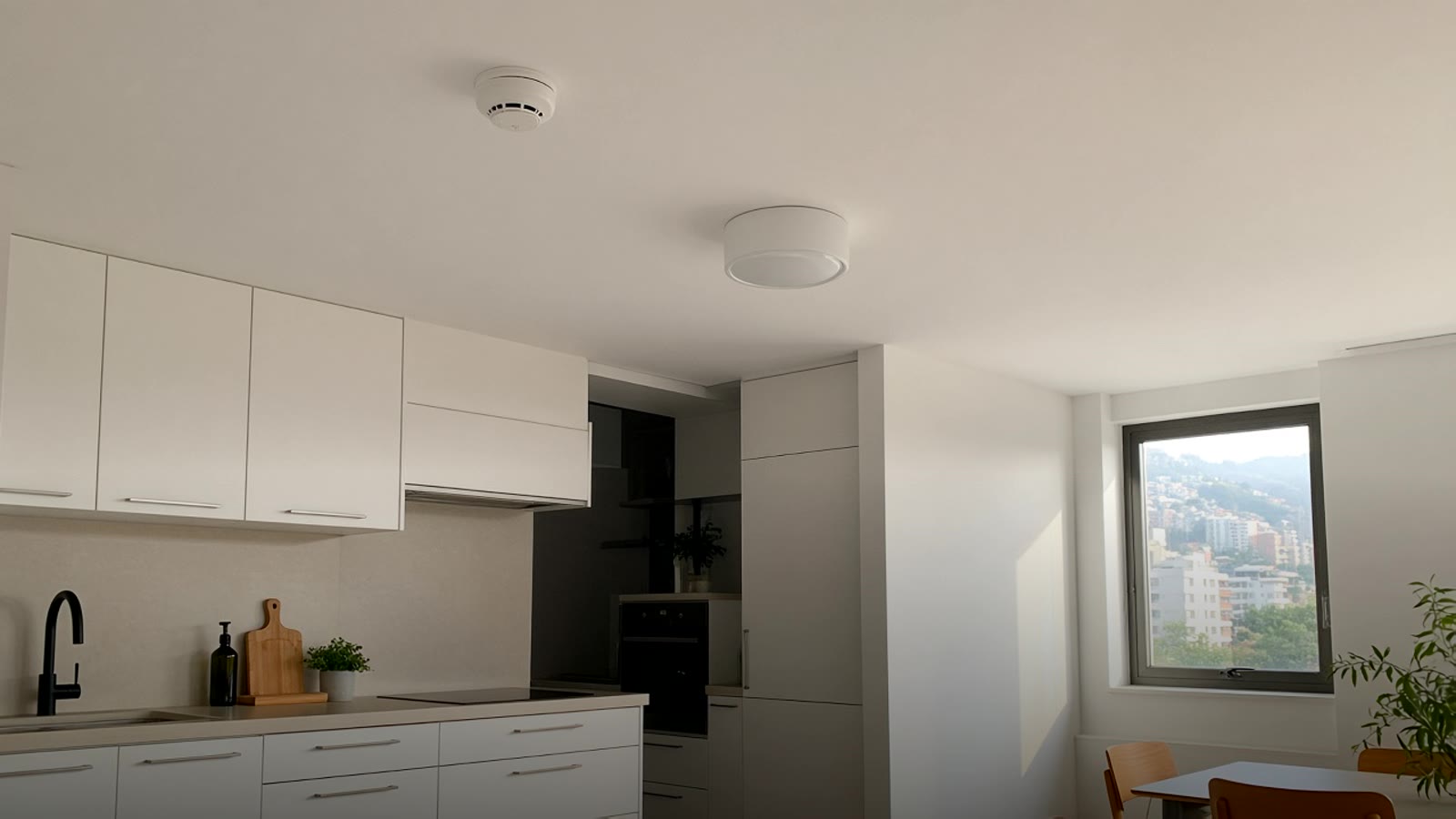
Smart smoke detector: how to protect a Medellín home from fire and gas
A smoke detector that beeps in an empty apartment helps nobody. How to choose smoke, gas, and carbon monoxide detectors that alert your phone, where to put them, and what to automate when they sound.
A common smoke detector does one thing: it beeps loud. If you are home, that is enough. If you are at the office, traveling, or asleep on the second floor with the door closed, that beep can go unheard.
A smart smoke detector does the same, but it also alerts your phone and can trigger other things in the house. That difference is the one worth paying attention to.
Smoke, gas, and carbon monoxide are not the same
Before you buy, separate the three risks, because each one needs a different sensor:
- Smoke. It is the warning of a fire. A smoke detector catches it, ideally photoelectric, which reacts well to smoke from slow fires like a cable or a mattress.
- Gas. In Medellín most houses and apartments have piped natural gas, and some farms use cylinder gas. A leak is detected with a gas detector, not a smoke one. The gas detector for the home guide covers height, Wi‑Fi/Zigbee, and what to do when it sounds.
- Carbon monoxide. It comes from poorly ventilated combustion, for example a gas water heater in a closed room. It has no smell and you cannot see it. Only a carbon monoxide sensor detects it.
A device labeled "smoke detector" almost never detects gas. If your home has a gas stove or heater, you need both.
Where each one goes
Placement matters as much as the device:
- Smoke detector: on the ceiling, in the bedroom hallway and in the living room. Away from the stove and the bathroom, because steam and cooking smoke trigger false alarms.
- Natural gas detector: natural gas is lighter than air and rises, so the sensor goes high, near the ceiling and near the stove or heater.
- Cylinder gas detector: propane is heavier than air and sinks, so the sensor goes low, near the floor.
- Carbon monoxide detector: in the room where the heater is and near the bedrooms, at the height the maker indicates.
Each maker ships its own install guide. Follow it before any general rule.
Which kind of smart detector to choose
There are three ways a detector connects to the house:
- Zigbee. These are battery detectors that talk to a local hub, like Home Assistant with a Zigbee antenna. There are models from Aqara, Heiman, and Frient, among others. The upside is that the alarm arrives even if the home's internet drops, as long as the hub stays on.
- Wi-Fi. They connect straight to the router, with no hub. Shelly has a Wi-Fi smoke detector that integrates with Home Assistant. They are easy to install, but they depend on Wi-Fi working.
- Common detector with a sound sensor beside it. If you already have normal detectors and do not want to replace them, a sensor that listens for the beep can send the alert. It works, but it is less reliable than a detector that reports on its own.
Our preference is Zigbee or Matter, because everything runs locally. We explain why in Zigbee and Thread at home.
Before you buy, confirm that the model can be shipped to Colombia and that it is certified for the type of gas you have at home.
What to automate when it sounds
Here is the point of having it connected. With Home Assistant, when a detector triggers you can make it:
- Send a notification to your phone, and to whoever lives with you, even if you are away from home.
- Turn all the house lights on at full brightness so you can see the exit at night.
- Turn off the AC or the fan, so it does not move smoke through the house.
- If it is gas, cut power to outlets near the kitchen with a smart plug or a relay, so you do not add sparks.
- Have the cameras save what happened, if you have them. See home security cameras.
There are motorized valves that shut the gas line when the sensor detects a leak. They are useful, but gas work in Colombia must be done or reviewed by a certified technician. Do not change it on your own.
When the power goes out
EPM outages are part of life in some neighborhoods. A battery detector keeps working without power, but the phone alert depends on the hub and router staying on. That is why it makes sense to put the hub and router on a small UPS. We cover that in power outages and smart homes.
If the detectors are battery powered, Home Assistant alerts you when the battery is low, which is better than hearing a beep at three in the morning without knowing which one it is.
Maintenance
- Test each detector once a month with the test button.
- Check the expiration date on the device and replace it when it arrives.
- Clean the dust off it now and then, especially during construction or in rainy season.
Where to start
If you are only going to put one today, put a gas detector near the stove or heater, and a smoke detector in the bedroom hallway. With those two and a phone notification you already cover the two most common risks in a home with gas.
If you are building full security, also see home alarm, door and window sensors, and water leak detection. And if you want to see what makes sense for your home, the smart home test takes a couple of minutes. For the full picture, see home automation in Medellín.