Water leak detection: a home that shuts the valve itself
How to protect your home from leaks and flooding with a motorized shutoff valve, flood sensors, drain sensors, and tank level monitoring.
A water leak almost never gives you warning. The washing-machine hose bursts on a Saturday afternoon, the toilet float sticks while you are away, the water heater starts dripping underneath with nobody watching. By the time someone notices, the water has already reached the wood floor, the kitchen cabinet, or the apartment below.
Water leak detection flips the order of events. The home notices the water first, closes the main inlet, and alerts you. What would have been a renovation ends as a mop and a repair visit.
In this article we explain the four pieces we work with: the motorized shutoff valve, flood sensors, drain sensors, and tank level monitoring.
The motorized shutoff valve
This is the central piece. It installs on the main pipe, right after the inlet shutoff, and has a small motor that turns the valve open or closed. From the outside it looks like a compact box mounted on the pipe. Inside it is a ball valve—the same kind of shutoff you already have at the meter—driven by a motor.
When any sensor in the home detects water where it should not be, the valve closes in seconds. It does not matter if you are asleep, at the office, or out of the country. The home cuts the water and sends a notification with the exact place the leak was detected.
Details that matter when you choose one:
- Manual override. If power goes out or the motor fails, you must be able to operate it by hand.
- It reports its state. Sending a close command is not enough. The valve should confirm it actually closed.
- Correct diameter. A valve smaller than the pipe reduces pressure for the whole home.
- It can be exercised. A valve that never moves for years can seize. We schedule a short close-and-open cycle now and then, at a time when nobody is using water.
A plumber does the install. The main pipe has to be cut, the valve mounted, and everything sealed and tested. We choose the equipment, integrate it into the home system, and define the rules, but the pipe work is done by an experienced plumber.
Flood sensors where trouble usually starts
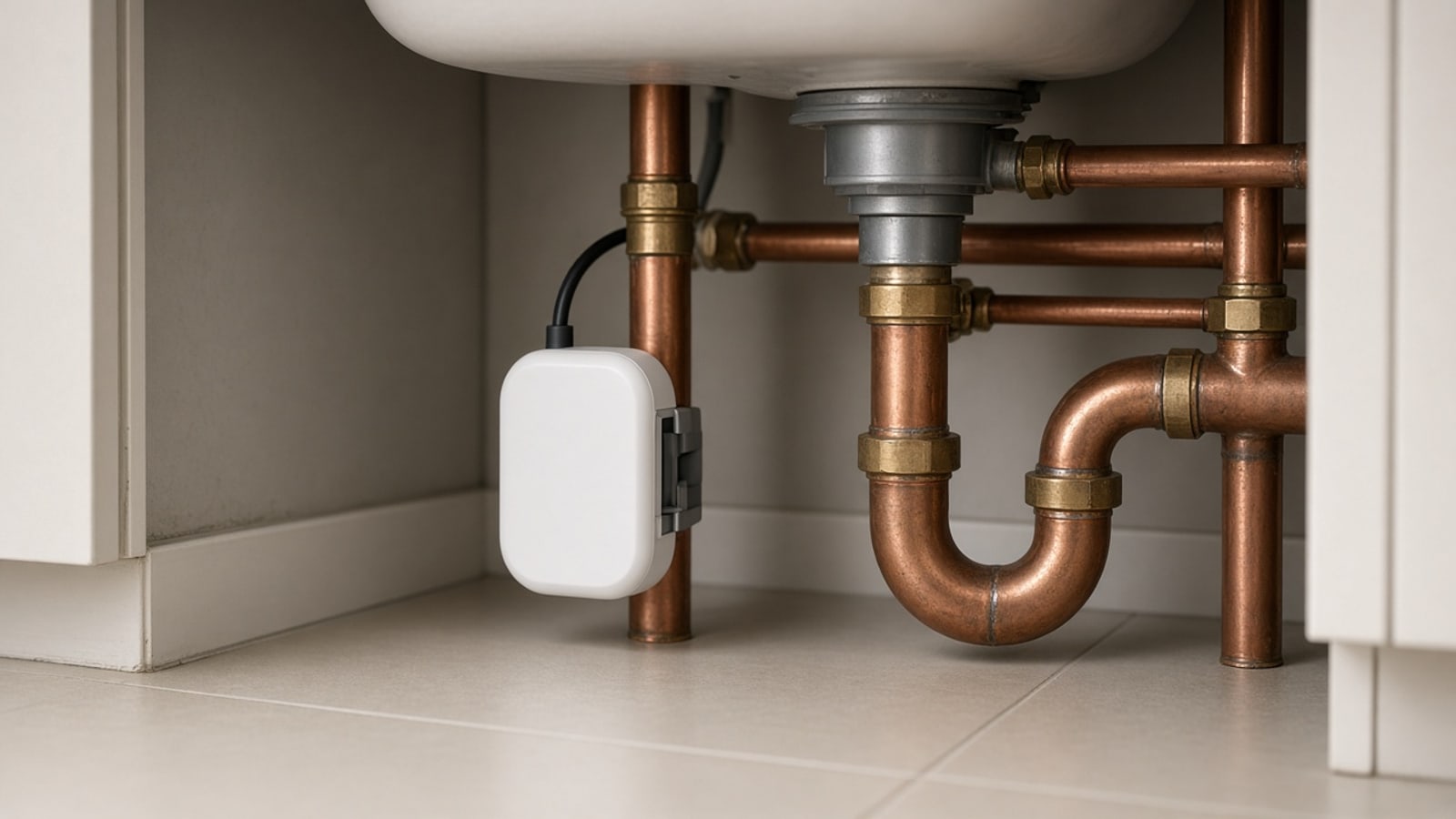
A flood sensor is a small disc that sits on the floor. Underneath it has two metal contacts. When water touches them, the circuit closes and the sensor sends an alert. They run on batteries that last a long time, because they spend almost all their time asleep.
You do not need to fill the house with them. They go where leaks historically start:
- Under the kitchen sink, where the trap, flexible hoses, and sometimes a water filter live.
- Behind the washing machine, which has pressurized hoses and a drain pump.
- Next to the water heater, tank or tankless.
- Under bathroom sinks.
- Beside the fridge if it has a water dispenser or ice maker.
- In the mechanical room or utility point, where the pipes come in.
Many flood sensors run on Zigbee. They are low-power end devices: they do not repeat the signal; they depend on nearby mains-powered devices that do. That is why they work well in a home that already has a solid mesh, as we explain in the Zigbee and Thread guide. A sensor under the sink, behind a cabinet and near metal pipe, is exactly the kind of place where Wi‑Fi fails.
Drain sensors: knowing when water is flowing
Flood sensors detect water on the floor. But some leaks never reach the floor, because the water goes where it is supposed to go—only it never stops.
The classic case is a toilet that keeps running. The float does not close properly and the tank lets a thin stream into the bowl all day. It is not loud, nobody sees it, and the bill arrives doubled. The same happens with a bathroom faucet left open, a garden hose forgotten, or a washer that never finished draining.
For that we use drain sensors. They install on the outlet pipe of each fixture and detect when water is passing through. With that the home knows, for example:
- That the guest bathroom toilet drain has had flow for forty minutes, when a normal flush lasts under a minute.
- That the guest-room sink has water running at three in the morning.
- That the shower is still open even though nobody is in the bathroom.
Crossing that data with the home’s presence sensors makes the rules more precise. Water running with someone in the bathroom is normal. Water running with the bathroom empty for half an hour deserves an alert. If the home is in away mode and there is flow on any drain, the main valve closes.
Mounting depends on each home’s plumbing. At some points the sensor goes outside the pipe; at others the pipe has to be opened, and the plumber handles that on the same visit as the valve.
A chip that measures tank level
Many homes and buildings in Medellín have a reserve tank—on the terrace, in the basement, or in a utility room. It helps during water outages, but almost nobody knows how much water is in it at a given moment. You find out it is empty when you open the tap and nothing comes out.
With a small ESP32-based module and a level sensor, the tank becomes visible in the home app. The sensor can be ultrasonic, mounted on the lid, measuring distance to the water surface. Or it can be pressure-based, submerged at the bottom, measuring the weight of the water column. Both give continuous level, not just full or empty.
With that data you can:
- See the level anytime, in liters or as a percentage.
- Get an alert when it drops past a threshold, so you know in time to ration or call maintenance.
- Detect abnormal use. If the level drops at night when nobody is using water, there is a leak somewhere.
- Control the fill pump, turning it on when the level drops and off before it overflows.
If the tank is on the terrace or in a basement far from the rest of the network, sometimes a repeater is needed along the way. That is a detail we solve in the design.
How the pieces work together
The rules that connect the sensors do the real work. An example of how a home ends up configured:
- Water on the floor, any sensor: the main valve closes, everyone in the home gets a notification with the exact location, and lights in the affected room turn on if it is night.
- Continuous flow on a drain with nobody present: an alert arrives. If it continues past a set time, the valve closes.
- Home in travel mode: the valve closes on its own when you leave and opens when you return, unless someone opens it from the app.
- Tank level dropping at night: possible-leak alert, with a chart of the last few hours of level.
Everything is viewed and controlled from your own app, built for your home. Open or close the valve, see which sensor triggered, review history, and confirm everything is in order. No subscription.
What to plan for if you are remodeling
If the home is under construction, this is the best time to leave it ready. With walls open, the plumber can place the valve somewhere accessible, with room for the motor and an outlet nearby. Drains can be prepared for sensors without breaking anything later.
What this changes day to day
Most days nothing happens, and that is how it should be. The sensors are there, the valve is open, and the home works as usual. The difference shows up the day something breaks.
Instead of coming home from a trip to a lifted floor, you get a notification that there was water behind the washing machine, the valve closed within seconds, and the rest of the home is dry. You call the plumber, they change the hose, and you open the valve from the app.
That is how a home that gets ahead of you should work.