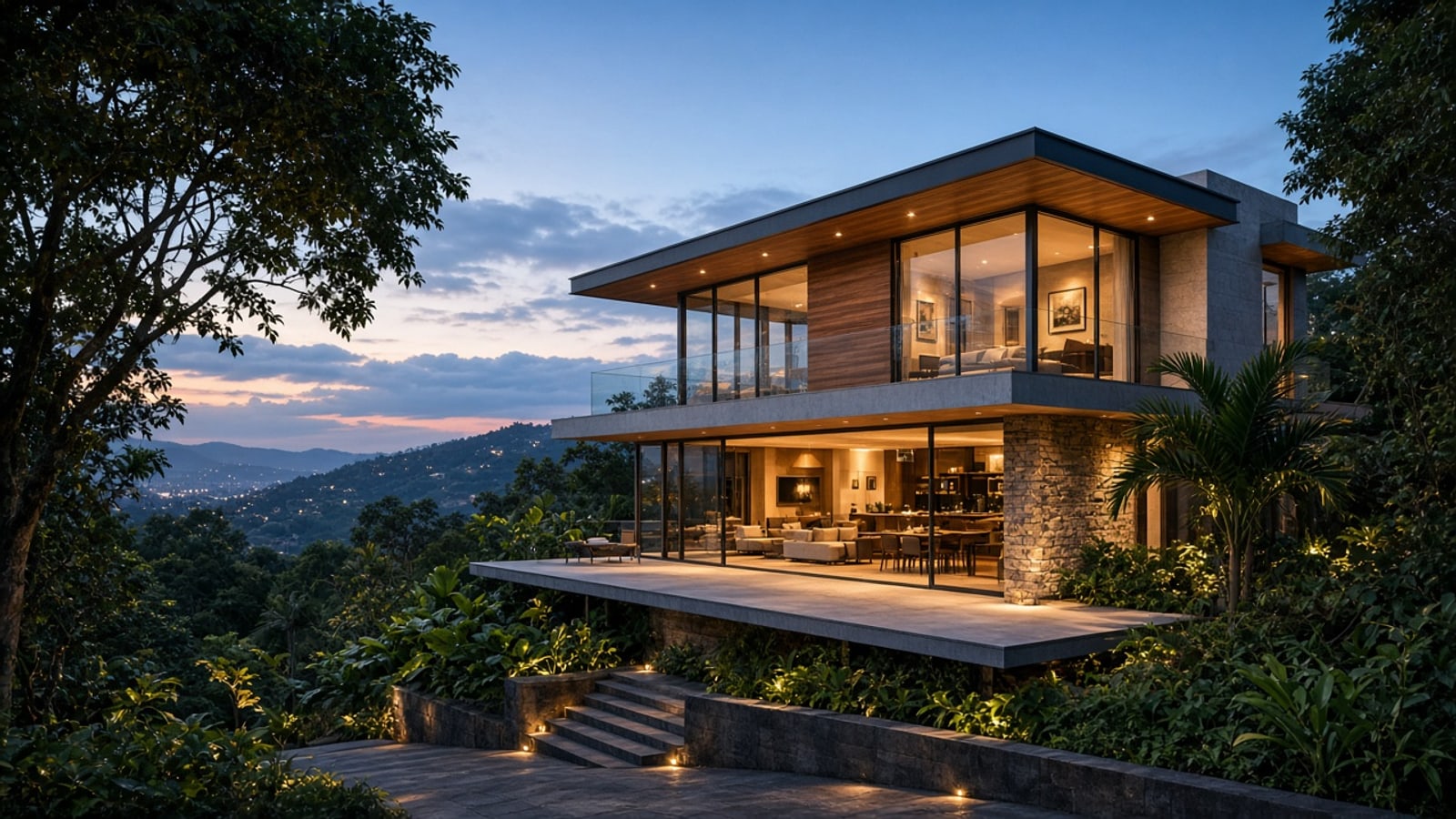
Home automation in Medellín: a guide for houses and apartments
What you can automate in a Medellín house or apartment, how to integrate the gear you already have, and what changes with the climate, power outages, and building rules.
A well-automated home isn't noticeable because of the gadgets. It's noticeable because it does what you need before you ask. The blind lowers when the afternoon sun starts heating the room. The AC turns on half an hour before you get home. The hallway lights come on softly at two in the morning and don't blind you. That's what we call a home that gets ahead of you.
This guide covers what you can automate in a Medellín home, how to work with what you already have installed, and which local details change the design: climate, power outages, and each building's rules.
What home automation is, in practical terms
Home automation is the set of devices and programming that lets the house react on its own. It has three parts:
- Sensors, which measure something: temperature, motion, a door opening, natural light.
- Actuators, which do something: a blind motor, a relay that turns on a light, an infrared emitter that talks to the air conditioner.
- Logic, which decides. It's the part almost nobody sees and the one that matters most. A well-thought-out rule — like "if the room goes above 25 °C and someone is there, turn the AC on at 23 °C" — is worth more than ten standalone devices with ten different apps.
Plenty of people in Medellín are already halfway there: a Wi‑Fi TV, a mini-split with a remote, cameras, an Alexa speaker. What's almost always missing is the logic that ties them together.
What you can automate in a Medellín home
Climate
Across much of the Aburrá Valley, mornings are cool and afternoons heat up — especially in apartments with west-facing windows or on high floors in El Poblado, Envigado, and Sabaneta. The mini-split often ends up running longer than it should, or off when you need it.
The approach we use most doesn't require replacing the unit. A small infrared emitter stands in for the remote, and a room thermometer tells the house the real temperature where you are — not the one the AC measures near the ceiling. With that, the AC turns on by itself, adjusts at night, and shuts off when you leave. We cover it in depth in the guide to smart air conditioning without replacing your mini-split.
Daylight and blinds
Motorized blinds and curtains are among the changes that most improve daily life. They can be scheduled by time, sun position, or temperature. A morning scene raises the blind gradually at wake-up time. An afternoon scene lowers it halfway when the sun hits the living room directly.
Lighting
Smart switches or relays behind the existing switch enable scenes: "arrive home," "dinner," "movie night," "night." In many cases you don't need to replace lamps or open walls.
Security and access
Smart locks, door sensors, cameras, and phone alerts. In buildings with a doorman, automation doesn't replace the guard. It complements them: you know who came in, when, and whether the door was left closed.
Energy
Measuring consumption by circuit helps you understand the EPM bill and spot equipment left on unnecessarily. It also helps the house behave well when the power goes out and when it comes back — a topic we cover in power outages in Medellín and smart homes.
Working with what you already have
The most common mistake is thinking automation means buying everything new. In most homes we visit, the opposite is true:
- Almost everything can be integrated. Mini-splits with infrared remotes, TVs, speakers, many cameras, and locks connect without replacement.
- You only add what's missing. A temperature sensor in the bedroom, a motor on the blind that gets the most sun, a relay on the hallway circuit.
- You replace what won't cooperate. Sometimes one or two devices are closed systems, with apps that talk to nothing else. Those get swapped for something that integrates.
The result is a single app, built for that home, with the names of your spaces and the scenes you actually use — not a pile of brand apps.
Apartments and buildings: what changes
Most clients in Medellín live in horizontal property (condominiums), and that brings its own rules:
- Facade. Many regulations don't allow changing windows or installing equipment visible from outside. Interior blind motors and infrared emitters don't touch the facade.
- Common areas. The intercom, doorman station, and building access belong to the co-ownership. You can integrate what's inside your unit. For everything else, you need to talk to building management.
- Construction hours. Many buildings limit noisy work to certain hours. A no-construction install with wireless gear fits better.
- Wi‑Fi. In concrete towers, signal drops between rooms. Before you automate, review the network — without a stable network, no automation is reliable.
If you're remodeling, it's a good time to leave conduit and network points where they'll be needed. If the apartment is already finished, almost everything can be solved without opening walls.
Power outages: design so you barely notice
In Medellín there are scheduled maintenance outages that EPM announces in advance, and storm-related cuts in the rainy season. An automated home has to handle both:
- The central system must start on its own and in order when power returns.
- Scenes must not get stuck halfway: if the outage hit while a blind was lowering, on return it needs to know where it is.
- A small backup for the router and controller keeps the house from "forgetting" what it was doing.
- Core logic must work without internet. If the ISP goes down, the house still responds.
How to choose a home automation company in Medellín
There are many options in the city, from big-brand integrators to curtain shops that motorize. Five points to clarify in the first meeting:
- Whether they work with your current equipment or propose replacing everything. A good proposal starts with an inventory of what you already have.
- Whether the house works without internet. Basic routines should run locally.
- Whether there's a monthly subscription. Some platforms charge you to use your own home. Worth knowing upfront.
- Who owns the configuration. If you change providers, the house should keep working.
- What happens after installation. Routines get tuned with use. The first weeks always bring adjustments.
How we work
- We visit your home. We walk every space and note what's there: lights, AC, blinds, locks, sound, network.
- We connect what already works. We only add what's missing, with discreet hardware installed carefully.
- We replace what won't cooperate. If one or two devices won't integrate, we swap them.
- We show you what your home can do. You get your own app, built for that home and with no subscription. From there we look together at what else is possible.
In short
Home automation in Medellín works best when it adapts to the city: to the afternoon heat, to the building with rules, to the storm that cuts the power. You don't need to replace what you already have. You need to unite it with logic designed for your home, so the house gets ahead and you don't have to think about it.
If you want to know what's possible in your house or apartment, book a visit.