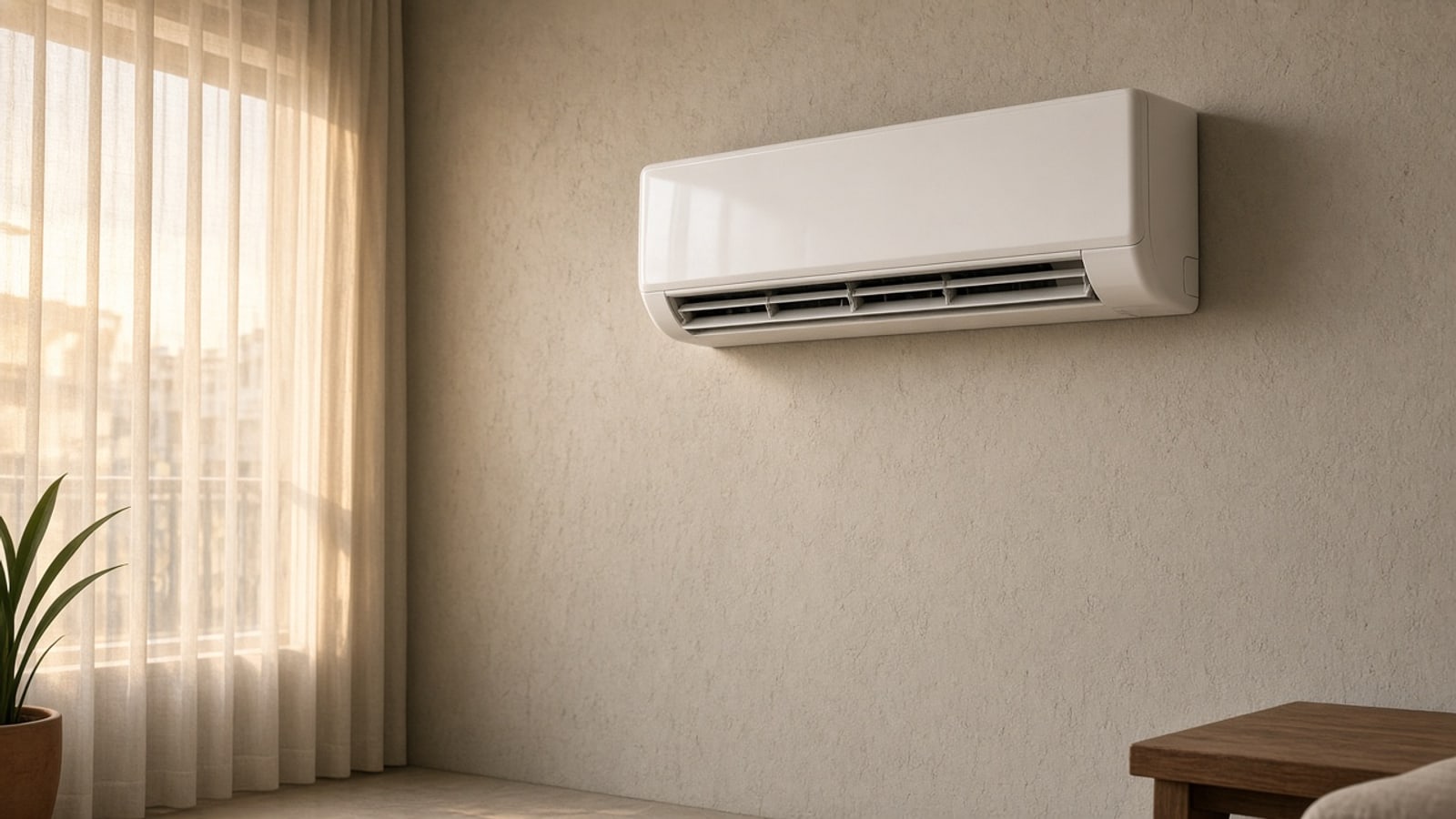
Smart air conditioning without replacing your mini-split
Turn the mini-split you already have into smart AC with an infrared emitter and a room thermometer. A guide for homes in Medellín.
When people search for "smart air conditioning," almost everything they find is new Wi‑Fi units. Those are fine machines — but if you already have a mini-split that cools well, replacing it just to control it from your phone means throwing away gear that works.
There's another path, and it's the one we use in most homes: keep the AC you already have and give it the two things it's missing — a way to take commands, and a way to know the real temperature in the room.
Why a mini-split isn't smart even with a remote
A typical mini-split has two limits:
- It only obeys the remote. If you're not home, or you're asleep, nobody presses the button.
- It measures temperature poorly. The sensor sits inside the indoor unit, high on the wall, near the air coming out. That reading almost never matches what you feel in bed or on the sofa.
That's why something very common happens in Medellín. You set the AC to 22 °C at ten at night; by two in the morning the room is freezing; at six you wake up with a stuffed nose. The AC did what you told it. The problem is nobody told it the night had already cooled down.
The two pieces that change everything
1. An infrared emitter
It's a small device, about the size of a matchbox, placed in the room with line of sight to the AC. It learns the signals from the original remote and sends them when the house decides: on, off, change temperature, mode, or fan speed.
- You don't open the unit or touch the mini-split's electrical side.
- The manufacturer's warranty isn't affected, because from the AC's point of view it's still receiving orders from a remote.
- It works with most infrared-remote mini-splits; we confirm your model on the visit.
2. A room thermometer
A small sensor, placed where you actually are: near the bed, on the desk, at sofa height. It measures temperature and often humidity. With that data the house decides for real, instead of guessing.
Together, these two pieces turn a remote-controlled AC into one that runs itself.
What the house can do with that
Cool before you arrive
If the house knows you're on the way — or simply that you get home at seven on weekdays — it can turn the AC on at six-thirty. You walk into a cool room without leaving it running all afternoon.
Adjust the night
This is the routine clients appreciate most. An example:
- 22:00: the room is at 26 °C. The AC turns on at 22 °C.
- 23:30: the thermometer reads 23 °C. The house raises the setpoint to 24 °C.
- 02:00: it's cooler outside. If the room drops below 22 °C, the AC turns off.
- 05:30: if it rises again, it turns on gently until wake-up time.
You don't have to think about anything. You sleep better because the temperature stays steady.
Coordinate with blinds and windows
The AC works less if the blind lowers when afternoon sun hits the window. In apartments facing the west side of the valley, that combination makes a big difference. With a window sensor, the house can also turn the AC off when someone opens up for a breeze.
Shut off what was left on
You left with the AC running. The house notices — the leaving scene fired, or there's been no motion for an hour — and turns it off. You just see the notification.
Medellín: a climate that needs fine control
Medellín is famous for mild weather year-round, but inside a single home the differences are large:
- High floors and big windows in El Poblado, Envigado, Sabaneta, or Belén take a lot of afternoon sun.
- Interior rooms can stay cool while the living room is hot.
- Nights cool down. An AC setting that worked at nine can be too much by three.
- Rainy seasons drop temperature and raise humidity. On those days dry mode sometimes makes more sense than cool.
That's why a fixed schedule works poorly. What works is measuring the room and reacting.
If the AC already has Wi‑Fi
Some newer units ship with factory Wi‑Fi and the brand's app. Integration is possible, but each case needs review:
- Some brand apps only work over the internet. If the brand's service fails, you lose control.
- Several brands in one home mean several apps. The goal is one.
- The temperature sensor is still in the indoor unit, so a room thermometer remains useful.
When factory Wi‑Fi integration is reliable, we use it. When it isn't, the infrared emitter is usually more stable.
What happens in a power outage
When power returns, many mini-splits restart in the last state or stay off, depending on the model. The house needs to know which happened and correct it. If the lights went out at three in the morning and came back at three-twenty, the night routine should pick up where it left off. In the guide to power outages in Medellín we explain how to prepare the rest of the home for that.
What installation looks like
- Visit and review. We look at each unit: brand, location, remote, line of sight, and where you spend time in that room.
- Device placement. The emitter goes where it isn't obvious but has a clear shot. The thermometer sits at the height where you are, away from the air outlet and direct sun.
- Programming. We load your remote's signals and build arrival, night, and leaving routines around your schedule.
- Tuning. The first weeks we fine-tune temperatures and timings based on how you sleep and use the home.
Everything lives in your own app, built for your home with no subscription, alongside lights, blinds, and anything else that integrates.
In short
Smart air conditioning doesn't have to mean a new AC. With an infrared emitter and a room thermometer, the mini-split you already have starts cooling before you arrive, adjusts itself at night, and turns off when it isn't needed. It's one of the simplest upgrades — and one of the ones you notice most day to day.
To see how it fits with the rest of the home, read the Medellín home automation guide or book a visit.