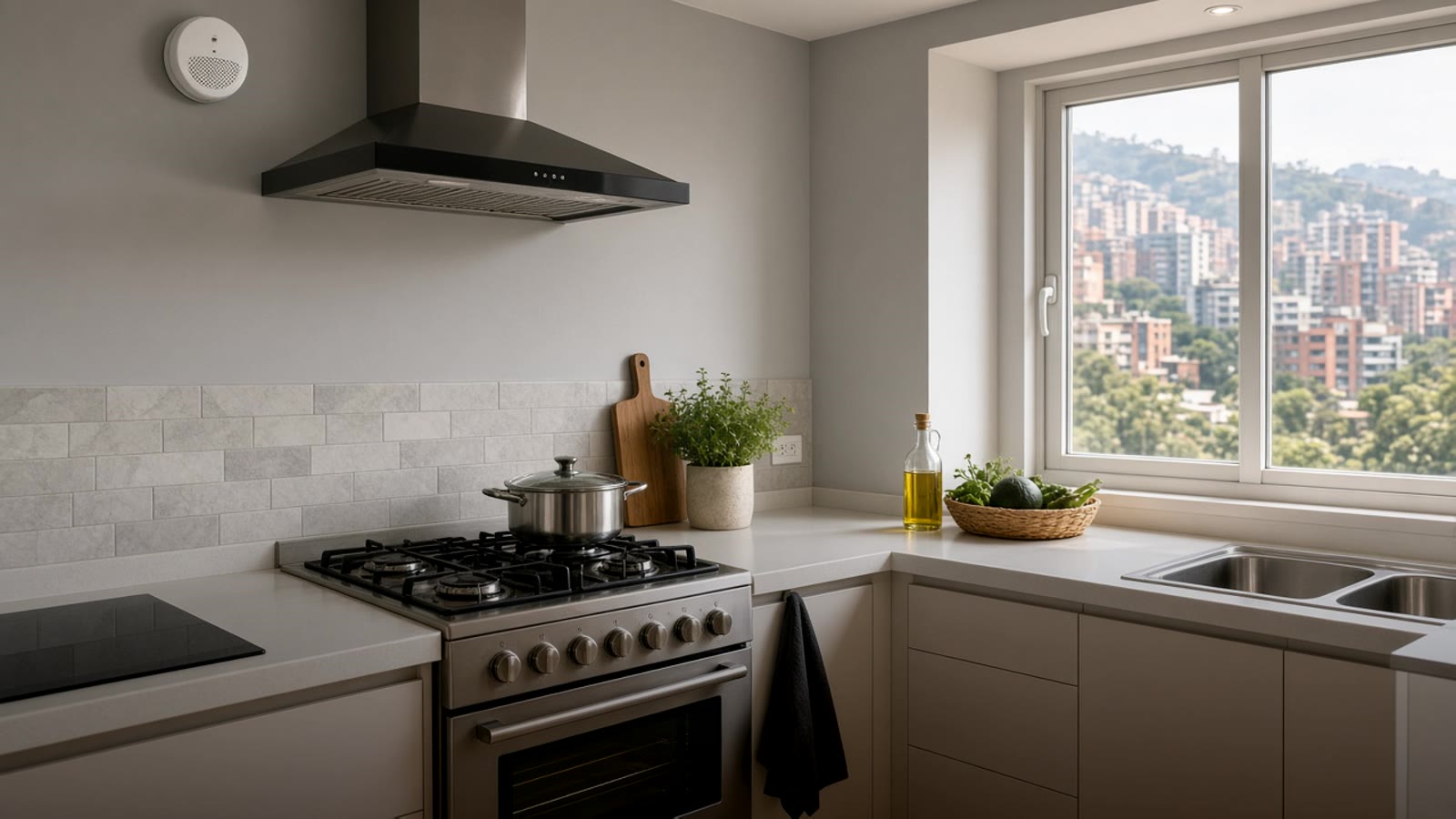
Gas detector for the home: where to put it and how to make it alert your phone
How to choose and install a natural-gas or cylinder gas detector in Medellín, what height each one needs, why carbon monoxide needs a separate sensor, and how to connect it to Home Assistant.
In most Medellín apartments the stove — and often the water heater — runs on piped natural gas. It is convenient and cheap to use, and almost nothing ever goes wrong. But a knob left half open, an old hose, or a poorly ventilated heater are things you do not always notice in time, especially if you are asleep or out of the house. A gas detector is for that: to smell before you do and to alert you.
This guide explains which kind of detector you need, where it goes, and how to make the alert reach your phone instead of beeping alone in an empty home.
First: which gas you have at home
Not every detector works for every gas, and mounting height depends on the gas:
- Piped natural gas. What reaches most buildings and houses in the Aburrá Valley. It is lighter than air, so when there is a leak it rises and collects near the ceiling.
- Cylinder gas (LPG or propane). Common on farms, vacation homes, and some areas off the grid. It is heavier than air, so it sinks and stays near the floor.
Some detectors recognize both, but many are calibrated for only one. Check the datasheet for which gas it detects before you buy.
Carbon monoxide is something else
A gas detector warns when there is unburned gas in the air — that is, a leak. Carbon monoxide is different: it comes out when gas burns poorly, for example in a tankless heater with bad ventilation or a blocked flue. It has no smell and a normal gas sensor will not detect it.
If you have a gas water heater inside the apartment, it is worth also putting a carbon monoxide detector, or a combined unit that measures both. For smoke and fire there is another kind of sensor; we cover it in smart smoke detector.
Where to put it
For natural gas: on the wall, high, about 30 centimeters from the ceiling, in the kitchen and near where the stove or heater is.
For cylinder gas: low, about 30 centimeters from the floor, near the stove or where the cylinder sits.
In both cases:
- Do not put it right above the stove. Steam and cooking grease cause false alarms and dirty the sensor.
- Avoid putting it next to a window or an extractor fan, because incoming air dilutes the gas and the detector takes longer to react.
- If the heater is in a laundry patio or another space, that space needs its own detector.
- Follow the distances the manufacturer gives in the manual; the ones above are the general reference.
Standalone, Wi‑Fi, or Zigbee
The basic wall unit. You plug it in, it beeps loudly when it detects gas, and that is it. It works well if someone is always home to hear it. If you are traveling, nobody finds out.
Wi‑Fi. It joins the home network and sends a notification through the manufacturer's app. Easy to install, but the alert depends on internet and the brand cloud working at that moment. Shelly Gas, for example, is a Wi‑Fi detector that can also be used in Home Assistant without going through the cloud.
Zigbee. It talks to a coordinator inside the house, such as Home Assistant, instead of going to an external server. If internet drops, the house still reacts: a siren sounds, lights turn on, whatever you programmed runs. The phone notification goes out when the connection returns, or through a backup if you set one up. If you are building the home on Zigbee, Zigbee, Thread, and Matter explains how the network works.
Many gas detectors with a Tuya or Smart Life app are Wi‑Fi or Zigbee underneath; in Tuya and Smart Life with Home Assistant we explain what to expect if you already have one.
What matters: that the detector is plugged into power or has a reliable backup battery, and that it self-tests or has a button to test it.
What the house can do when it detects gas
With the detector connected to Home Assistant, the alert stops being only a beep:
- Notify everyone. A notification to every household phone, even when people are out, and a critical alert that sounds even if the phone is on silent.
- Siren and lights. If it is night, hallway and kitchen lights come on so nobody walks in the dark.
- No extra sparks. What you should not do is turn things on or off near the leak. So automations should act on lights and appliances away from the kitchen, not on kitchen ones.
- Shut the gas. There are motorized valves that close the gas line when the detector trips. A valve on the gas line must be installed by a technician certified by the gas company — it is not a DIY project.
- Alert a neighbor or the doorman. If you live alone or travel a lot, the same alert can go to a trusted person who has a key.
What to do if it sounds
The detector buys time, but what you do next is what counts:
- Do not turn lights or appliances on or off, and do not use matches or lighters.
- Close the gas shutoff valve if you can reach it safely.
- Open doors and windows.
- Leave the house and call your gas company's emergency line, or 123, from outside.
Maintenance
Gas sensors lose sensitivity over the years. Check in the manual how often the manufacturer recommends replacing it and write the install date on the device. Test it with the test button now and then and clean it with a dry cloth — no aerosol products nearby, because some aerosols make it sound or damage it.
Where to start
If you have natural gas, a high detector in the kitchen is the first step. If there is also a gas heater indoors, add a carbon monoxide detector. When you want those sensors to work with the alarm, water leak sensors, and the rest of the house, start with Home Assistant in Colombia. If you do not know what to automate first, take the smart home test, and for the full picture see home automation in Medellín.