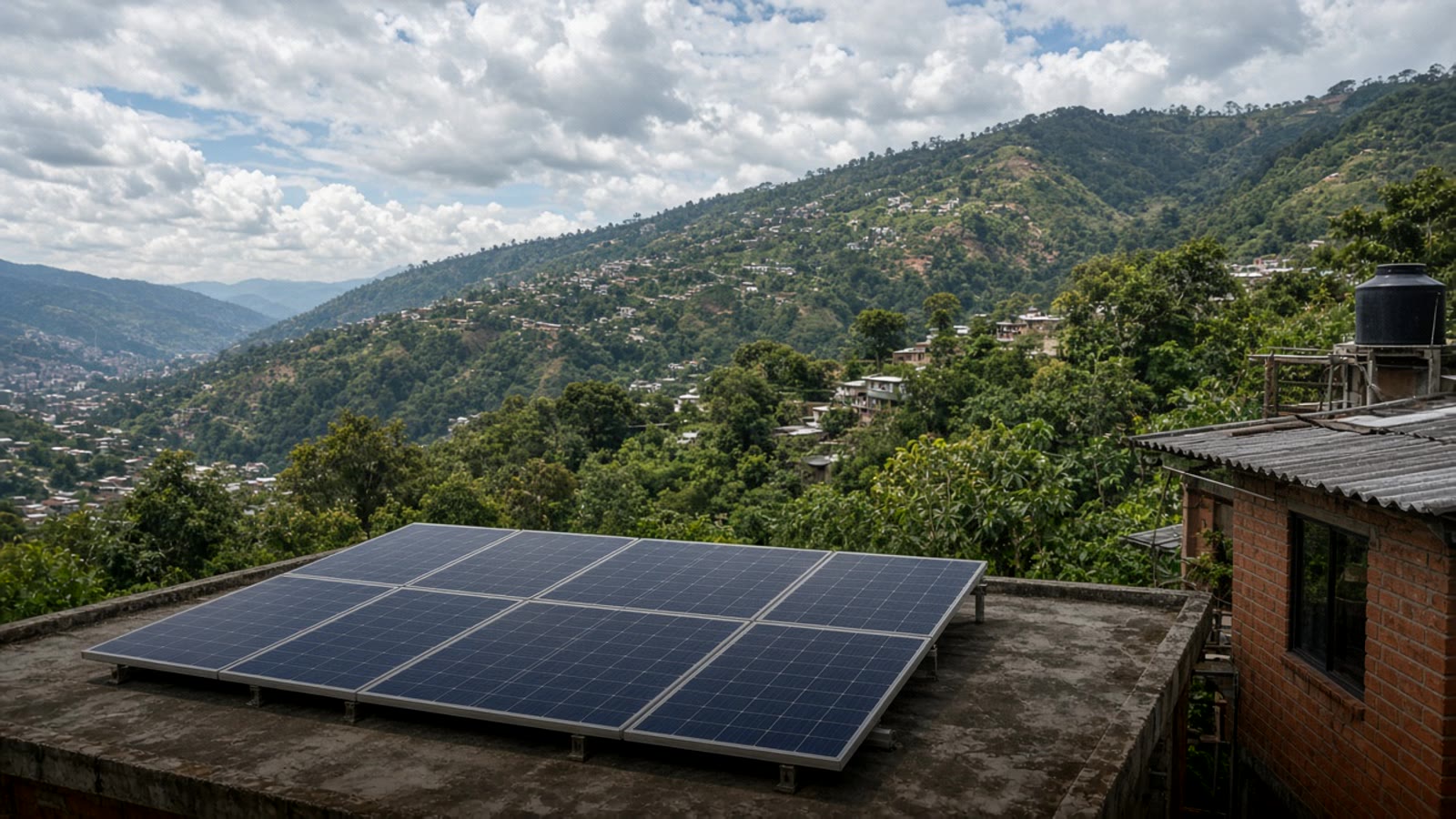
Solar panels in Medellín: how to measure what they produce and use it better at home
A guide for Medellín homes with solar panels—or planning to install them: what to measure, how to connect the inverter to Home Assistant, when to run loads on surplus, and what to check with EPM.
Medellín has sun almost year-round, but also clouds that come and go in minutes. That’s why two homes with the same panel system can produce different amounts, and why measuring beats guessing.
This guide isn’t about choosing panels or an installer. It’s about connecting the home to what the system produces: seeing generation in real time, knowing how much you consume, and shifting loads to sunny hours. If you’re thinking about installing, this guide helps you know what to ask the installer. If you already have panels, it helps you get more out of them.
What’s worth measuring
A home solar system has three numbers that matter:
- What the panels produce. The inverter reports it.
- What the home consumes. Measured at the panel.
- What enters or leaves the grid. The difference between the first two, and what the bidirectional meter records if your system exports surplus.
Most inverter apps show only the first. Without the other two, you don’t know whether midday energy is being used in the house or sent to the grid.
Connecting the inverter to Home Assistant
Many common inverters in Colombia integrate with Home Assistant, through the manufacturer’s cloud or the local network. Local is better: it responds faster and keeps working if the internet drops. Before you buy, ask the installer which inverter brand they use and whether it exposes data over Modbus or a local API. That answer weighs more than almost any other spec when the goal is automation.
For home consumption, a Shelly meter with clamps at the panel measures without cutting the service entrance cables. We explain it in detail in home electricity monitoring. With generation and consumption in the same dashboard, Home Assistant calculates the rest and builds the energy board with day, week, and month charts.
Using energy when there’s sun
Here’s the practical gain. If you know midday has surplus energy, you can schedule the home to use it then:
- Water heater. If it’s electric, a relay turns it on when there’s surplus and leaves it ready for the evening shower. In hot water for the shower we cover the options.
- Air conditioning. Pre-cool a room at midday on your own energy instead of at 7 p.m. on grid power. See smart air conditioning.
- Washer, dryer, and dishwasher. With a smart plug that measures consumption, Home Assistant tells you when it’s a good time to run them.
- Electric car. If the charger has an integration, you can limit charging to what the panels produce.
The rule we use is simple: a load turns on from surplus only after energy has been leftover for several minutes, not from a two-second spike between clouds. That keeps the heater from cycling on and off all day.
Alerts that actually help
- If midday production under a clear sky is much lower than similar days, there may be dirt, new shade, or a failed panel.
- If the inverter stops reporting, a notification hits your phone.
- At month end, a summary of what was produced, consumed, and exported to the grid, to compare with the EPM bill.
Surplus, EPM, and regulation
In Colombia, small-scale self-generation is regulated by CREG Resolution 174 of 2021, and Law 1715 of 2014 gives incentives for renewables. If you want to export surplus to the grid, the system needs to be registered with the network operator—EPM in Medellín—and have a bidirectional meter. The installer normally handles that paperwork. Before you sign, confirm it’s included and ask for the registration documents.
Power outages
One point that confuses people: a grid-tied system without batteries shuts down when the power goes out, for the safety of technicians working on the line. If what you want is backup, you need a hybrid inverter with batteries, and a decision about which circuits stay backed up. We cover that in power outages in Medellín.
Where to start
If you already have panels, start by measuring home consumption for two weeks alongside production. With that data you’ll see which loads are worth moving to midday. If you don’t have a system yet, measure consumption first—that’s what the installer needs to size it well. And if you want to see what to automate in your home, take the smart home quiz. The full picture is in home automation in Medellín.