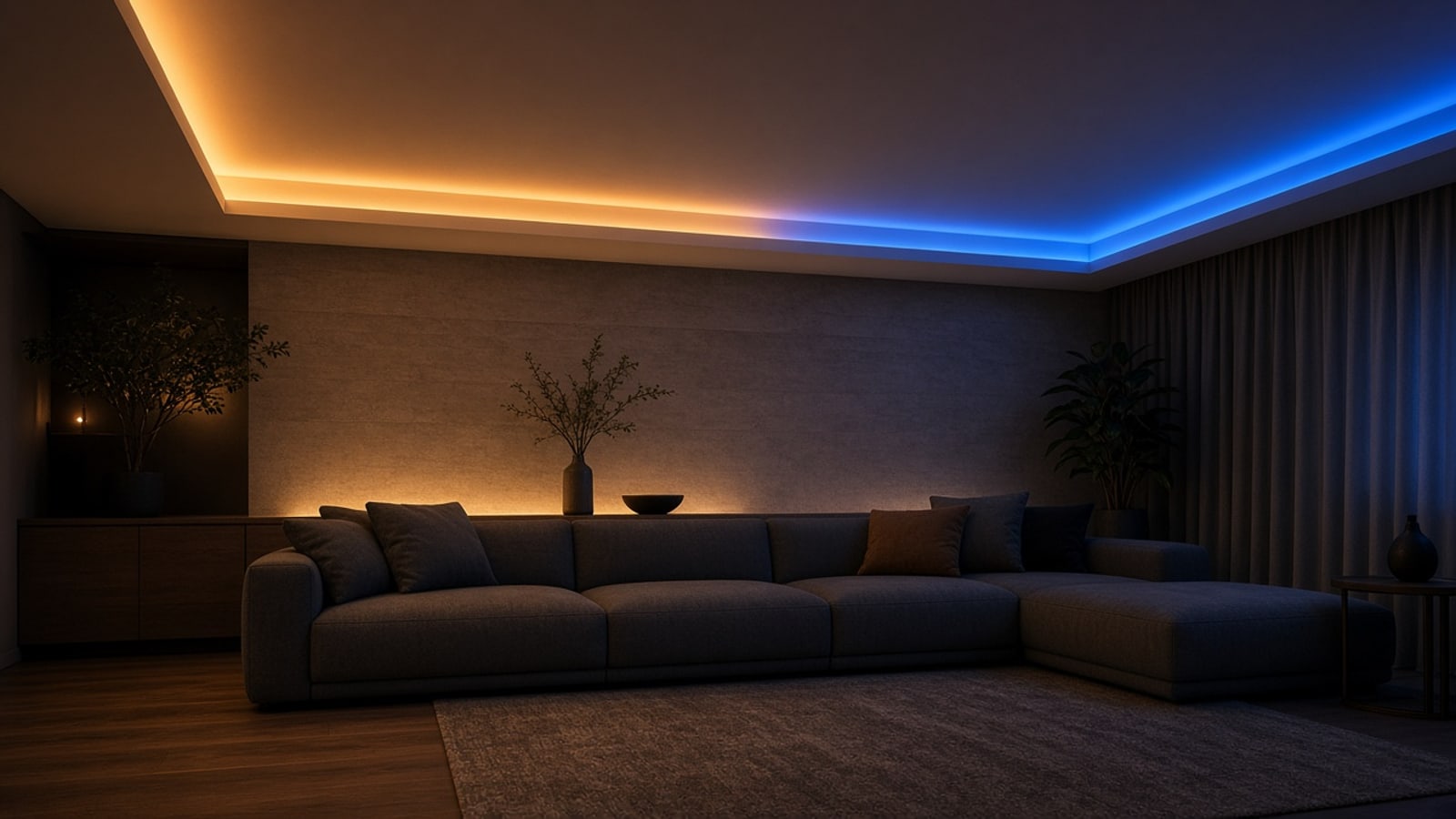
LED effects and scenes with WLED and Matter
WLED on ESP32, Zigbee, and Matter over Thread versus brands locked in the cloud. Effects, stair lights, motion paths, and home scenes—all local.
I am the founder of Domótica Medellín. I like a cove that runs a slow sunset. I like a staircase that lights step by step when you come down in the middle of the night. I do not like that magic depending on this month’s Chinese app still being online, on the brand’s server not having shut down, or on firmware that forces you to create an account to turn off the hallway light.
This note is about open, local control, effects worth having, and how to tie them to the home’s scenes. The base on strips, power supplies, and profiles is in the LED lighting technical guide. Color and night criteria for Medellín are in warm lighting.
Electrical safety note. ESP32 boards, 5 V/12 V/24 V injection, level shifters, and power supplies need care: polarity, wire gauge, a fuse where it belongs, and no improvising on 110/220 V. If you are not confident with the electrical side, do not improvise; at Domótica Medellín we install it properly.
Open and at home versus a cloud that dies
There are two philosophies on the market:
- Closed brand. Looks great the first month. Everything goes through their cloud. If the building’s internet drops, they change the API, or the company pivots, your strip becomes an expensive dumb bulb.
- Local control. The brain is on your network: Home Assistant (or another hub you control), Zigbee, Thread/Matter when the device is mature, WLED on an ESP32 for addressables. Internet is a plus for the phone away from home, not the main switch.
In Medellín, in apartments where Wi‑Fi is already fragile between walls, betting 100% on a brand’s cloud is asking for frustration. Same standard we ask for blinds and climate in home automation in Medellín: the basics should run without the fiber provider.
WLED on an ESP32
For addressable strips (WS2812, SK6812, and kin), WLED on an ESP32 is the tool I use most. It runs on the local network, has effects to spare, and integrates with Home Assistant without drama.
What it handles well:
- Effects by segment (not the whole house on “rainbow”).
- Presets you later fire from a scene.
- Brightness and color with smooth transitions.
What I do not improvise: clean power, a solid common ground, and often a level shifter if the strip is 5 V and the ESP32 speaks 3.3 V. A “just testing” desk install is not the same design as an eight-meter cove.
Zigbee for the everyday; Matter when it helps
Zigbee is still my workhorse for white, CCT, relays, and sensors: its own mesh, low power, less fighting with the neighbor’s Wi‑Fi. Serious Zigbee strip controllers behave like another citizen of the home.
Matter over Thread comes in when the device is stable, the home’s border router is clear, and you gain future interoperability without handing control to a single app. I do not rip out everything that already works on Zigbee overnight “because Matter is the future.” I add Matter where the product is ready—not where marketing is three years ahead of the firmware.
In all three cases the rule is the same: the logic lives in the home. Presets, schedules, and scenes should not vanish if tomorrow’s cloud service of the week shuts down.
Effects I actually use (and the ones I leave as decoration)
Candle and fire
A slow candle or fire flicker on a fake fireplace, a corner, or a short cove. In dinner or “good night” mode it does more than shouty RGB. Less saturation, more warmth: it fits warm light in Medellín.
Slow sunset
Drop brightness and shift white toward warm over 15–30 minutes. It is the natural complement to the Aburrá Valley sun when the sun is gone. You can trigger it by time, by a light sensor, or when you leave a “day” mode.
Stairs and motion paths
Strip on a handrail or baseboard, sometimes addressable “per step,” with motion sensors at the start and end. Late at night: low intensity, warm, no flash. By day: often off or nearly off. The goal is not a show; it is not to trip and not to wake the whole house.
What I almost never leave on Monday through Friday
Full rainbow in the family living room, endless DJ modes, cold white strobing. Those stay for a one-off party or the teenager’s room that asked for them. The everyday home deserves more visual quiet.
Home scenes and schedules
Loose effects get old. What sticks is tying them to life:
- Good night: bathroom paths at minimum, everything else off, AC and blinds in their sleep logic.
- Movie / cinema: task lights off, ambience very low; if there is a media center, the same scene powers screen and sound.
- Arriving home: hallway and living room at a medium warm level, not 100%.
- Sunset: an automation that does not depend on you remembering to dim by hand.
All of that lives with the rest of the automation we outline in the smart home guide for Medellín. A good scene is a habit; a loose effect is a toy.
Buying criteria, in one sentence
If the product only shines inside its app and cannot live on your local hub, I treat it as disposable. If it speaks Zigbee, well-implemented Matter, or is controlled with WLED/ESPHome on your network, we build on top of it.
At Domótica Medellín we design and install this lighting and its control: from strip and power supply through WLED, Zigbee, or Matter, integrated into your scenes. If you want to see what fits your home, write to us from the site.