Home LED lighting: a technical guide
COB vs SMD, tunable white, RGB and addressables, how to size the power supply, aluminum profiles, and Zigbee controllers. What I check before installing in a home.
I am the founder of Domótica Medellín. When someone asks me to “put LEDs” in a Medellín apartment, the problem is almost never the strip itself. The problem is choosing the wrong type, undersizing the supply, hiding the driver where it cannot breathe, or buying a controller that only lives in the cloud. This guide is what I check before cutting the first meter.
If you are still framing the home, start with home automation in Medellín or the guide to starting a smart home. Here I go into the technical detail of the light.
Electrical safety note. Power supplies, power injection, splices, and any connection to 110/220 V should be done by someone who knows what they are doing. A poorly powered strip overheats, a supply without ventilation fails, and undersized cable can burn. This note guides design; it does not replace an electrician or local codes.
Strip types: COB, SMD, and what actually matters
COB versus SMD
SMD strips carry discrete LEDs (5050, 2835, and similar). Up close you see dots. With a good diffuser they look fine; without one, on a ceiling or mirror, you notice the “dots.”
COB (chip on board) emits a continuous line. For cove, under-cabinet kitchen, or an exposed profile, I almost always prefer them: fewer dots, more even light, and a cleaner finish when the client walks up close.
COB is not “better at everything.” On very tight curves or cheap hardware-store lengths, quality varies. Dense, well-profiled SMD is still valid. The decision is aesthetic and about use, not fashion.
Tunable white: CCT, CW, and WW
A CCT (or tunable white) strip mixes cool and warm on the same circuit. With two channels (CW/WW) you adjust color temperature without changing the fixture. In Medellín that matters: by day there is a lot of natural light; at night you want warm. I develop that in warm lighting for Medellín homes.
If you are only going to leave one fixed temperature, a good WW strip is simpler and cheaper. Tunable white is worth it when the same cove serves reading, dinner, and sleep.
RGB, RGBW, and RGBCCT
- RGB: color, no real white. Mixed “white” looks dirty.
- RGBW: RGB plus a dedicated white LED. Better for color scenes and useful light.
- RGBCCT: color plus cool and warm white. The most flexible and the most demanding on wiring and controller.
For a living room that sometimes wants ambience and sometimes decent light, RGBW or RGBCCT. For a hallway that is only accent, fixed WW is sometimes enough.
Addressables: WS2812, SK6812, and family
On addressable strips each LED or group is controlled separately. That is where WS2812, SK6812, and variants come in. They are for effects, stair runs, and scenes that are not “the whole strip the same color.” The cost is more wiring, more care with the signal, and a controller that understands them (WLED on an ESP32 is the path I use most). I leave that in LED effects, scenes, WLED, and Matter.
12 V or 24 V, voltage drop, and injection
Why I almost always push 24 V on long runs
At 12 V the current is double that at 24 V for the same power. More current means more voltage drop in the cable and in the strip itself: the end looks dimmer or more orange than the start.
Practical rule on site:
- Short runs (under a cabinet, a mirror): 12 V can be enough.
- Coves, hallways, several zones in a logical series: 24 V and properly sized cable.
- If the end dims or shifts tone, do not “crank brightness to max.” Check gauge, length, and power injection.
Power injection
On long strips do not feed from one end only. Inject positive and negative (or whatever feeds the strip asks for) at several points, with a solid common ground/return. Without that you will fight uneven brightness even with a huge supply.
20% headroom on the supply
Add the watts of the strips at the brightness you will actually use (many are rated at 100% and almost never run there), add controllers and losses, and choose a supply with at least 20% headroom. A supply at the limit ages badly, buzzes, and fails when you need it most.
Consumption: plan in watts per meter
Before buying, ask for (or measure) W/m of the specific strip, not the number from a generic ad. Then:
- Meters per zone × W/m = power for that zone.
- Sum zones that can be on at once (“arrival,” “party,” etc.).
- Size supply(ies) and cable for that peak, not the day’s average.
In kitchen and bath it sometimes makes sense to have one supply per zone. On a long cove, sometimes one central supply with injections. The important thing is not to put “the whole apartment on one cheap 5 A supply.”
Where to hide drivers and supplies
The supply and driver need three things: ventilation, access, and circulating air. I never seal them inside drywall with no access panel. I never put them in a closed niche above the ceiling with no way to service them.
Places that do work:
- Technical closet or communications room, with a grille or free space.
- Under-cabinet with ventilation and a removable cover.
- An accessible junction box near the cove, not buried.
If a Zigbee driver or dimmer ends up behind a panel nobody will open for five years, the day it fails you will break finish. Design for maintenance.
Aluminum profiles and diffusers
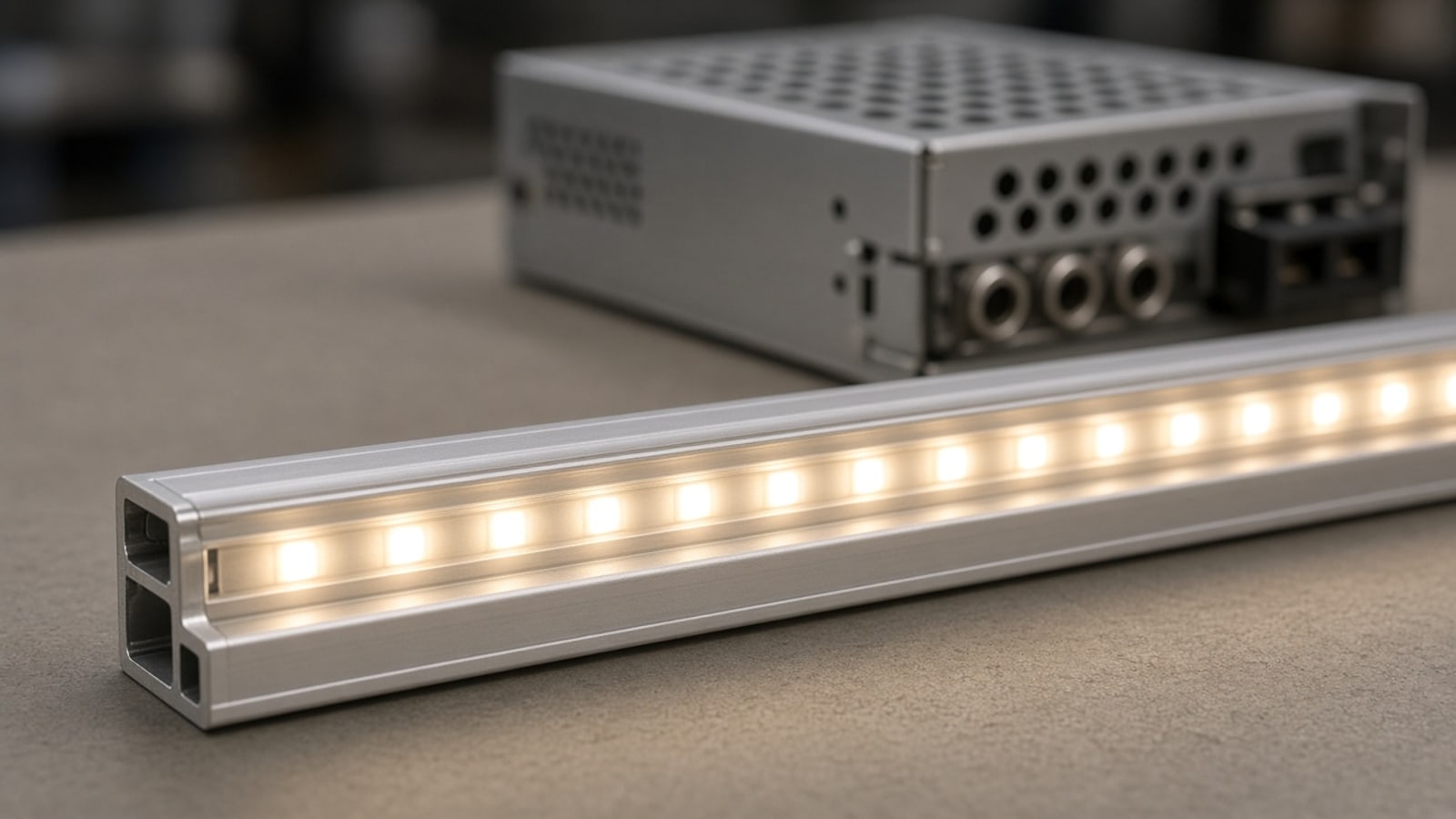
The profile is not decoration. Aluminum dissipates heat, straightens the strip, and the diffuser kills the dots. Without a profile, many COBs and almost all SMDs look amateur from two meters away.
Choose the profile by the cut: recessed, surface, corner. A milky (opal) diffuser homogenizes more; a clear one leaves more lumens and more LED texture. For ceilings and mirrors, almost always opal.
Cut clean, use end caps, and avoid visible splices mid-cove. An LED install is judged by the joints, not by the catalog brightness.
Zigbee controllers
For white or CCT integrated into the home, a Zigbee controller (or Zigbee relay/dimmer on the circuit) is my default: local mesh, less drama with building Wi‑Fi, and one logic with the rest of the sensors.
What I ask of the controller:
- That it talks to the home’s coordinator (Zigbee2MQTT / ZHA or whichever stack we use), not only the brand app.
- That it supports the strip type (PWM 1–5 channels, or the addressable protocol).
- That it survives a power cut without ending in a weird state; in Medellín that is not theoretical. See power outages and the smart home.
If the project needs per-LED effects, Zigbee alone is not enough: that is where WLED or another local brain comes in, always under the same home, not under an account that can close tomorrow.
How it fits the rest of the home
The electrical and product side is half. The other half is what light you want at eight at night and how it ties to scenes. Color temperature and layers I cover in the warm light in Medellín post. Effects, Matter, and open control, in WLED, scenes, and Matter.
At Domótica Medellín we design and install this kind of lighting: strip, supply, profile, controller, and the logic in your app. If you want to review your case, write to us from the site.